
Investment Advisory Robot
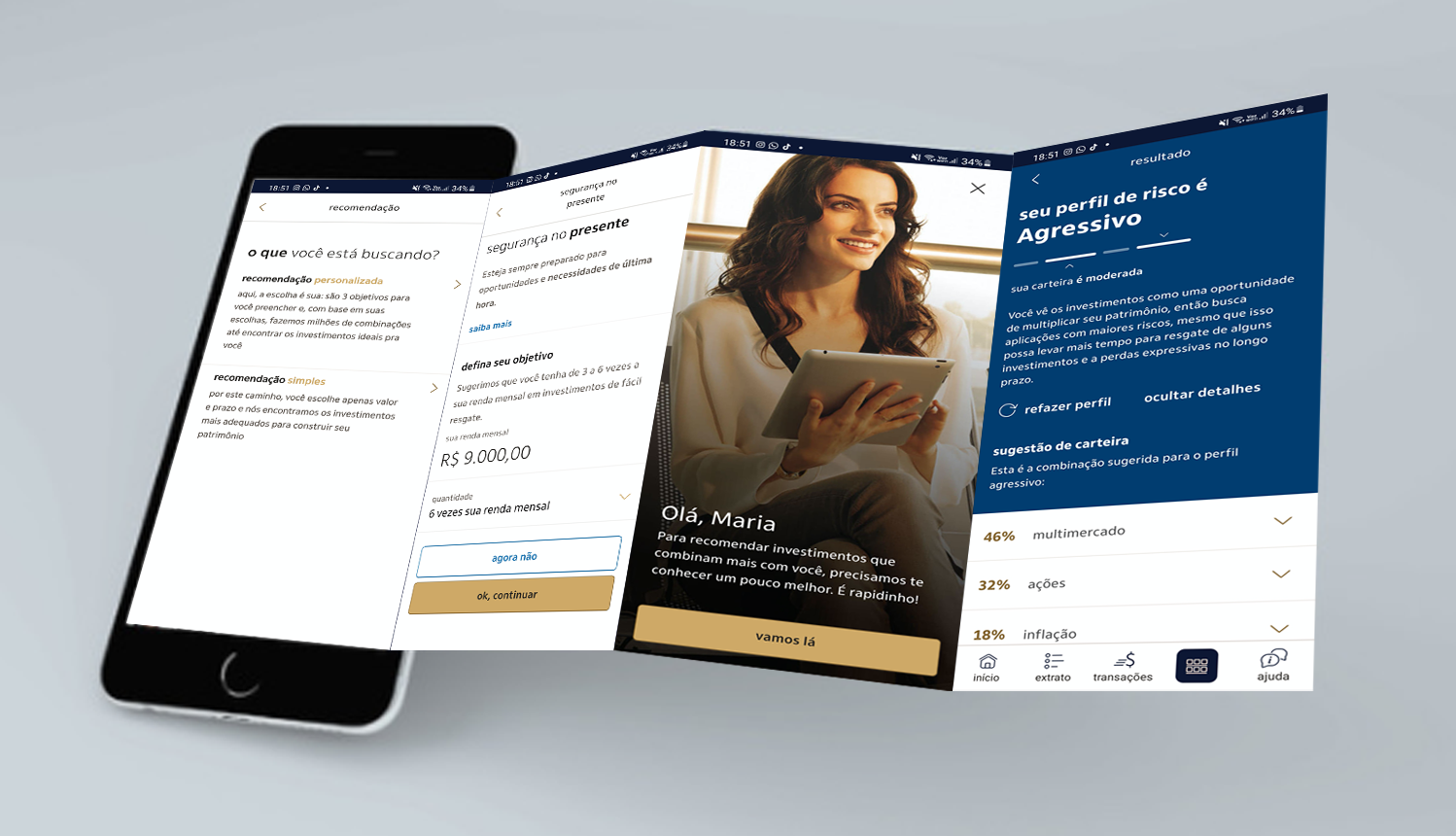
Project Details
Role: Product Designer
Company: XP inc
Year: 2018
About Itaú Unibanco
Itaú Unibanco is one of the biggest banks in Latin America, it offers financial services ranging from bank accounts and credit cards, to complex brokerage investments. It was one of the first traditional banks in Brazil to go digital and is widely recognized for its digital experience.
PROBLEM
Itaú Unibanco wanted to increase its investor customer base and help customers invest more effectively by offering specialized financial advice. The solution needed to work across channels, such as web and mobile for a digital advisory experience, and also improve the advisor tools used in face-to-face financial guidance.
The initiative became one of the bank’s early explorations of AI applied to investment recommendations, and one of the first to investigate this technology as part of a customer-facing recommendation experience.
The ambition went beyond building a recommendation engine.
We needed to understand how AI could participate in a highly regulated, high-trust financial decision and how customers would react to receiving investment advice from an algorithm at a time when conversational AI was still unfamiliar to most people.
The project initially focused on a simple question:
How might we use technology to provide personalized investment advice at scale?
But this quickly became a much broader problem. We needed to understand:
- What makes an investment recommendation appropriate for each customer?
- What information does a customer need before acting on a recommendation?
- Would customers trust recommendations generated by AI?
- How much of the reasoning behind a recommendation should we expose?
- When should AI act directly, and when should it support a human advisor?
- How could we scale financial advice without sacrificing suitability or trust?
The initiative eventually expanded into three interconnected squads:
Digital Advisory: Customer-facing investment recommendations across mobile and web.
Assisted Advisory: Tools to help advisors provide better and more consistent recommendations.
AI & Recommendation Intelligence: The intelligence powering both experiences.
I worked across all three squads, connecting customer research, product strategy, interaction design, and the emerging AI capabilities.
THE CHALLENGE
DISCOVERY
Aligning the Organization
Different areas had different expectations of what we were building and this was delaying the effective start of the project, allocation and budget definition.
To solve this issue we started interviews with all the 13 stakeholder across Product, Investments, Channels, Technology, and Customer Experience.
To support with the final decision making I used a CSD Matrix to separate existing knowledge from assumptions. Areas of agreement became foundations for the product. Areas of disagreement became hypotheses to validate with customers.
Understanding Investor Behavior
Our initial exploratory research was designed to understand how customers made investment decisions and the role Itaú played in that process.
We quickly discovered that risk profile alone could not explain investor behavior. The recommendation experience needed to consider several dimensions:
Risk appetite / Investment knowledge / Desired level of autonomy / Emergency reserve / Financial goals / Amount to invest / Investment horizon / Recommendation
But one variable became particularly important:
How much control did the customer want?
That led us to identify three important behavioral profiles.
1. Independent & skeptical
" I prefer to decide myself"
Customers who did not fully trust investment advisors and preferred making their own decisions.
For some of them, an algorithm could actually feel more impartial than a human advisor, since they associated advisors with sales incentives or the bank's commercial interests.
2. Advisor-led
"I want to have an expert to do it for me"
Customers who trusted their advisors and valued human validation, particularly for complex or high-value decisions.
Technology could support their experience, but they were not interested in replacing the human relationship.
3. Independent, but not confident
"I want to understand and feel secure with an expert"
Customers who did not fully trust advisors but also did not feel comfortable investing entirely on their own. They wanted transparency and control, but also reassurance.
This third group challenged the assumption that the solution should simply be AI vs. human advisor.
HYPOTHESIS TO PRODUCT DECISION
Customers will interact with an AI investment advisor conversationally.
Our initial concept was intentionally futuristic for 2018: a personalized conversational investment advisor, represented by a character that customers could interact with as a "robot advisor."
The idea was to make investing feel more approachable and use conversation not only to recommend products, but also to educate customers throughout the journey.
Insight
Our early content-first tests helped us refine how recommendations needed to be explained. Customers needed to understand what they were accepting, why it was being recommended, and what the financial implications were.
But when we evolved those scripts into screen-based interactions, a deeper problem emerged: Customers were not yet comfortable treating a conversational interface as a trusted financial advisor.
The conversational model was novel, but novelty did not translate into confidence. Reading long conversational exchanges was also not how customers expected to consume complex investment information.
Product Decision
We moved away from conversation as the primary interaction model. Instead, we designed a structured, navigation-based experience focused on autonomy, allowing customers to quickly understand the recommendation and progressively explore its reasoning.
More financial education will make customers more sophisticated investors.
We initially believed that exposing customers to contextual investment education would gradually increase their financial knowledge and confidence. The experience therefore needed to both recommend and teach.
Insight
Customers appreciated having additional information available, but most did not consistently want to consume it. More importantly, the behavioral profiles we identified were more stable than we expected. Even as investing became an increasingly popular topic in Brazil, particularly in a lower-interest-rate environment, exposure to educational content did not quickly transform customers who preferred assistance into independent investors.
Product Decision
We stopped treating education as a mandatory path. Instead, we created an experience in layers:
Layer 1 - Decision: The critical information required to understand and act on the recommendation.
Layer 2 - Explanation: Why this recommendation fits the customer's profile and goals.
Layer 3 - Learning: Deeper content for customers who actively want to understand the investment, product, or strategy.
The experience could therefore serve customers with different levels of knowledge without forcing everyone through the same educational journey.
Customers need detailed financial information to trust a recommendation.
Investment products traditionally communicate sophistication through large amounts of financial information, charts, historical performance, comparisons, and projections. We initially assumed that providing more of this information would increase confidence.
Insight
Customers strongly associated investing with charts and financial visualizations. Their presence contributed to the perception that the recommendation was credible and grounded in financial analysis. However, most customers were not comfortable interpreting complex charts. This created an interesting tension:
Charts were important for perceived credibility, but complexity reduced actual understanding.
Visualizations combining multiple variables, benchmarks, or financial concepts could make the experience feel sophisticated while making the decision itself harder.
Product Decision
We treated financial visualization as both an information and trust component. Charts remained part of the experience, but they needed to communicate one clear message at a time. Instead of maximizing financial information density, we prioritized simple visual relationships, clear context, and progressive disclosure for customers who wanted deeper analysis.
AI should replace part of the traditional advisory experience.
A scalable digital recommendation engine initially suggested a straightforward direction: automate what advisors were doing manually.
Insight
Our research showed that there was no single preferred relationship with financial advice. Some customers trusted algorithms more than advisors, others trusted advisors more than algorithms and some trusted neither enough to make a decision without additional reassurance.
The real opportunity was therefore not choosing between human or AI. It was deciding where each created the most value.
Product Decision
We designed AI as an intelligence layer across two experiences.
Direct to customer: AI could generate personalized recommendations for customers comfortable with self-service.
Advisor augmentation: The same intelligence could support advisors internally, accelerating analysis and helping them provide portfolios better aligned with each customer's profile and goals.
This allowed the solution to scale while preserving human involvement where customers valued it.
From a Feature to an Investment Ecosystem
Another important insight emerged during testing. Itaú's main banking app contained accounts, payments, cards, insurance, credit, investments, and many other financial services. Investing required something different: more context, deeper analysis, portfolio monitoring, education, and ongoing recommendations.
We therefore pursued two directions. A simplified recommendation experience could remain within the main banking app. But we also started exploring a bigger hypothesis:
What if investments had their own digital environment?
That question eventually contributed to the development of ÍON, Itaú's dedicated investment platform.
The project also gave me deep exposure to investor behavior and the Brazilian investment market. That knowledge later enabled me to expand beyond my Product Designer role and take on a Product Manager role as the dedicated investment experience evolved into ÍON.